The Hacker Mind vs. Machine Learning
Why Biological Intelligence Still Has the Edge ... For Now

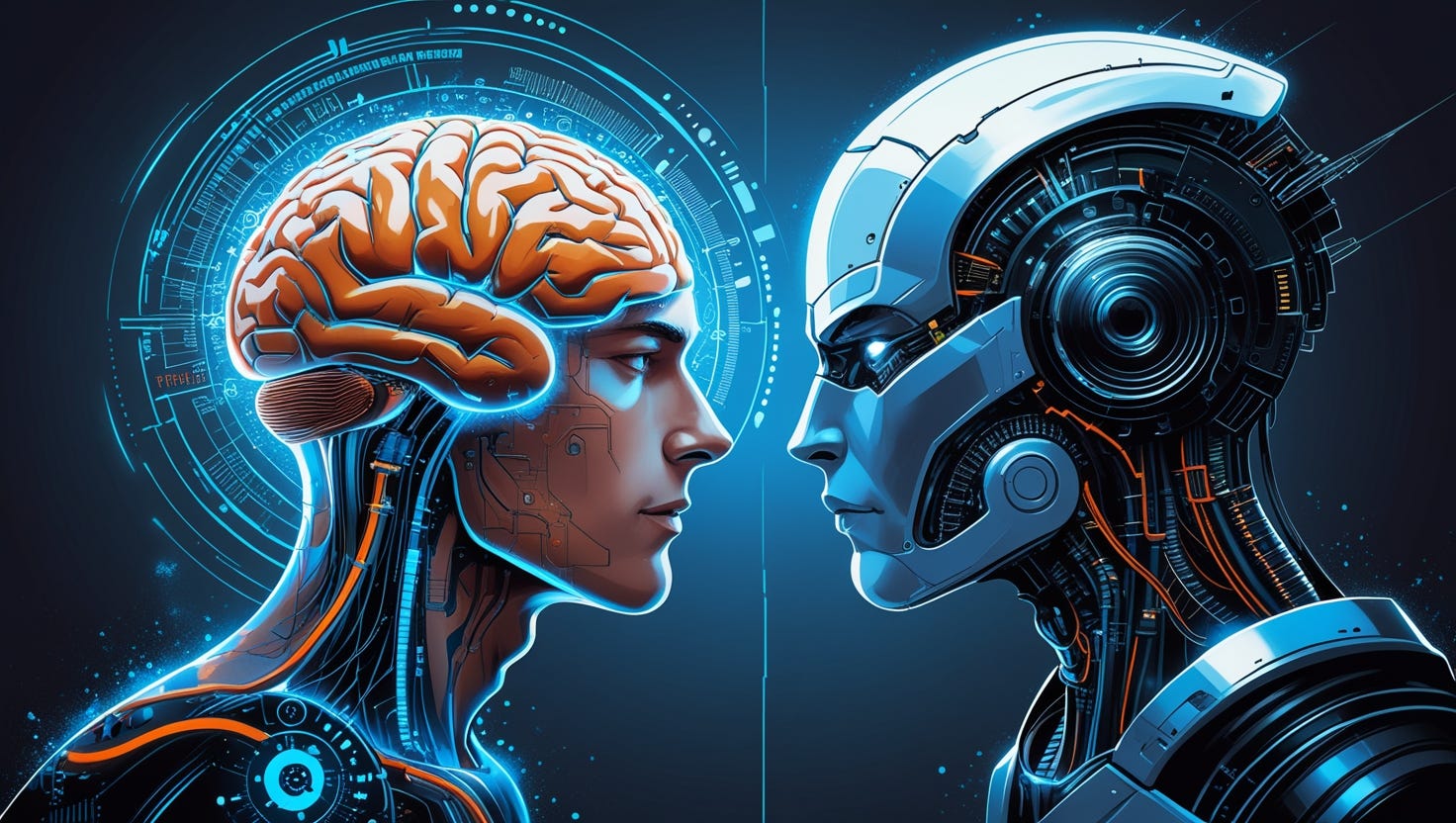
How far down the rabbit hole would have Alice ventured if constrained by her embedded 'on boarded' LLM data set of mind? Would curiosity still have prevailed? Was Neo's escape from the Matrix similar to an artificial intelligence singularity event, or was his "awakening" a result based on a total escapade from the data set which comprised his very existence?
Where do the common points of interconnect exist, between a Hacker and an AI "mind" and how do the divergent attributes of a biological and an artificial intelligence affect their reasoning and outcomes? Is logic the only prevailing prerequisite required in a technological endeavor or do human attributes such as, Curiosity, Intuition, Fortitude and Resilience really matter?
Ultimately, it is at the crossroads of logic and the human spirit where code meets curiosity, resilience contends with recursion, where both the hacker and the artificial mind reveal their deepest truths and limitations.
The Crossroads
Technological adaptation has driven our human advancement throughout the ages, it is with such advancements that brought us from nomads to farmers, from farming to the industrial revolution and from that point into the information age. At every juncture within our history there is a crossroads that exists, where a new way of being with reference to the world that we inhabit becomes our new reality. It is with this that we now find ourselves on the precipice of the AI age and beyond. A cross roads that begets the existential question of human relevance in a world slowly dominated at every crevice by our new AI companions and systems.
Given that aforementioned crossroads we now straddle, which force of nature will prevail ?
A Silicon Brain of acquired knowledge sought by acquisition through human mimicry. Data sets compromised of a digital amalgam of limited feeds, fed blindly into a system that has no soul or even sense of sentience?
or
A Biological Mechtronic Mechanism comprised of a group of beings that are driven by an inescapable life force striving to understand, conquer, love, live and connect. Knowledge collectively built over the ages through grit, epic failures, harrowing heartache and personal perseverance?
This eventual answer to these questions will be inevitably arrived at at some point at the next crossroads ...
"We are summoned to push humanity forward. We are at a fork in the road—one path leads to a future in which artificial intelligence helps elevate the human condition; the other risks eroding it. The decisions we make now will define the soul of the next era."
— Satya Nadella, CEO of Microsoft"
The Intelligence Problem
Certainly our human minds preconceive meaning and most often attach human traits onto non-biological entities, the same is true with our complex relationship with AI. The term "Artificial Intelligence" has us contemplating Intelligence on Silica, an artificial substrate that is supposed to imbue a human like "intelligence" quality. Whilst it could be argued that true intelligence is omniscient or all knowing, with an innate ability to effortlessly contrive facts, phrases, concepts and ideas.
Utilising a wealth of knowledge afforded to AI through its neuronal interconnected substrate it provides us with this ability, in a sense becoming our AI age version of the ultimate being. Yet with this ability AI still falls victim to hallucinations, narrow "thought" processes and often requires constant prompting, not unlike a child would in order to sway it back onto the correct path.
"The biggest concern is not that AI will develop a mind of its own, but that it will do exactly what we ask it to do."
— Stuart Russell, Professor of Computer Science, UC Berkeley
The Biological Remedy
Optimism, Fortitude, Curiosity, Motivation, Emotional Intelligence and Creativity are just some biological answers to The Intelligence Problem question. It is with these immutable human qualities that our most precious, inspiring and endearing biological feats have manifested. These combined qualities, in of themselves and when combined with the full magntitude of human adeptitude, encompass an unparralled intelligence that when dilegently harnessed in the right direction, are our most finest asset.
Where an AI may hallucinate, a human will look to integrate. It is with this inner sense of knowing, that most broadly distinguishes itself from a true thinking creature of this world in comparison to one that may error correct itself into an oblivious endless loop. To be inspired and curious gives light to an underlying motivational aspect unsurpassed, where the alternative is to idlely ingest data en masse to please its creator.
The remedy is transposed by the "why" and not born of the endless insatiable thirst for data collection. The ability to discern fact from fiction not the artificial figment of personification. The creativity in motion based on human emotion not fictitous ideals based on parameters and variables.
The Cyber Conundrum
Hackers rely on creativity and artistic license when contriving "solutions" to otherwise intentionally thought out behaviours or workflows within systems. It is the imperfections that are the guiding light, where the opportunity to strike or target is one born out of intuition through experience and understanding.
This is the human factor at work. This is where the current divide stands between Silicon and Carbon, between Emotion and Logic.
AI is therefore a tool ... an enhancement to a already thriving intelligence that when combined together for the greater good only amplify outcomes.
"AI is a dual-use technology: it can be a force multiplier for cybersecurity, but also for cyber threats."
— Brad Smith, Vice Chair & President of Microsoft
Final Reckoning
At this intersection of carbon and code, it is not superiority we must seek, but synergy. The true reckoning lies not in whether AI will replace the hacker, but in how the hacker will evolve with AI as both adversary and ally.
For all its processing power and recall, the artificial mind remains bound by patterns, permissions, and predictability, while the human hacker dances in chaos, driven by intuition, defiance, and the raw hunger to understand.
The reckoning is not a question of intelligence, but of will. It is here, in this crucible of cyber warfare and cognitive frontiers, that humanity must choose not to abdicate control, but to harness the machine without becoming one. The future will not be written by logic alone, it will be forged by those with the curiosity to question it, the courage to disrupt it, and the wisdom to guide it.